Demonstrated
The modified concept completed the full sequence. The tapered entrance provided qualitative self-guidance, with no visible trial damage.
MAGDRIVE / PROJECT 01
A mechanical interface proof of concept for replaceable solid-metal propellant: cartridge, receiving housing and gripper interface developed from requirements through benchtop testing.
Hardware development
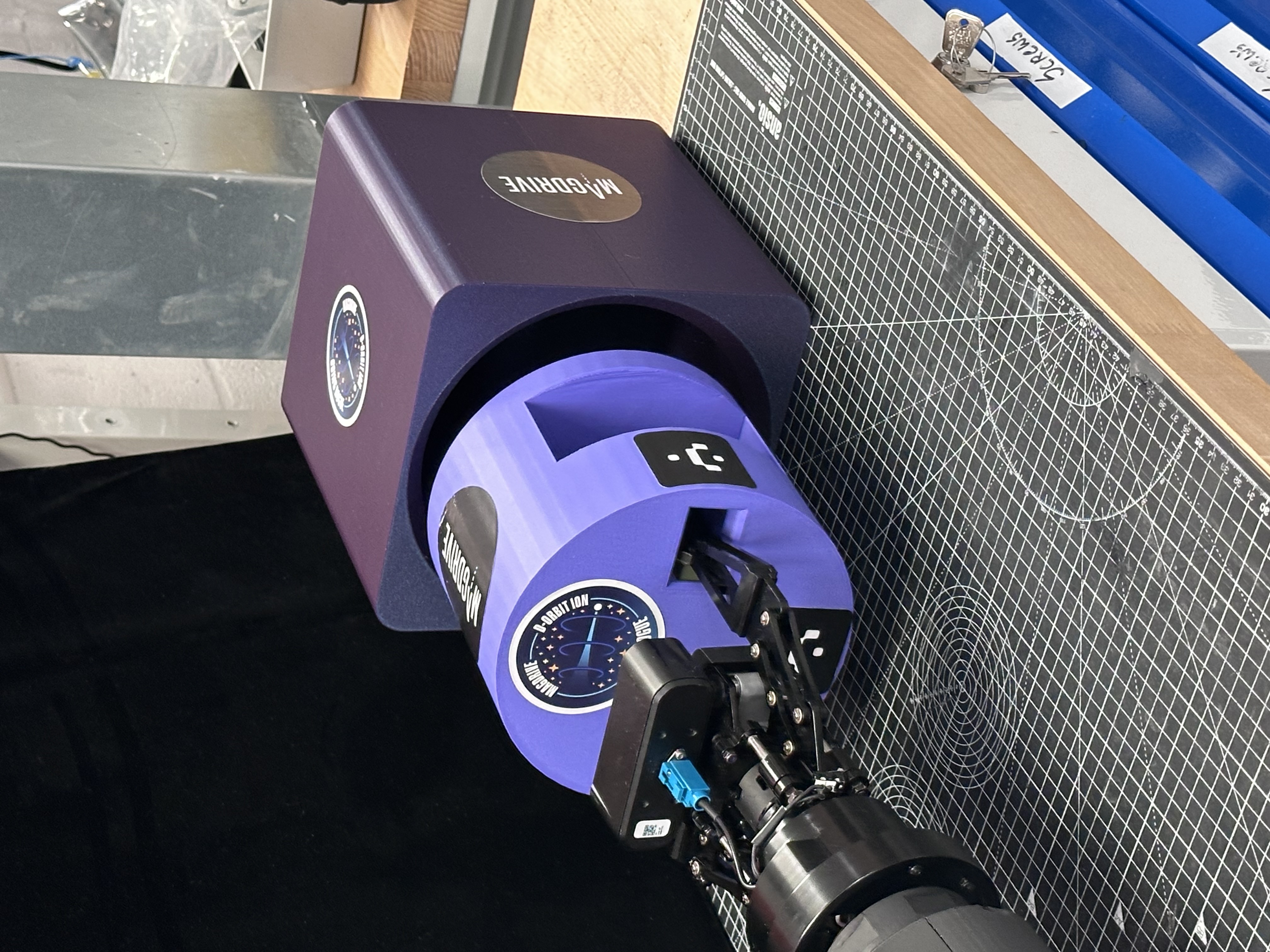
The work developed a cartridge, receiving housing and robotic gripper interface for solid-metal propellant refuelling. The concept progressed through requirements definition, trade studies, CAD, PLA prototyping, partner-hardware integration and benchtop testing.
I led the refuelling-hardware design and development within a four-person multidisciplinary engineering team, working with Magdrive engineering input and supervision.
Engineering approach
Concept comparisons focused on gripper compatibility, latch engagement and a hybrid interface. CAD iterations addressed insertion interference and handling. The dimensioned drawing appendix is available below.
Translate the refuelling problem into functional requirements.
Compare interface concepts and identify trade-offs.
Develop CAD geometry and PLA functional prototypes.
Run handling protocols and assess benchtop trials against requirements.
Test and evidence
The modified design completed the manual handling sequence: grip, insert, release, re-grip and withdraw.
The modified concept completed the full sequence. The tapered entrance provided qualitative self-guidance, with no visible trial damage.
Eight manual benchtop trials used PLA prototypes at room temperature, atmospheric pressure and Earth gravity.
Initial trials clicked during withdrawal. Later runs improved with alignment and wear-in after the modified pads engaged the cartridge gaps. The pad length increased from approximately 7 mm to 17.5 mm, incorporating a suggestion from Lodestar’s T. Santini.
Project evidence
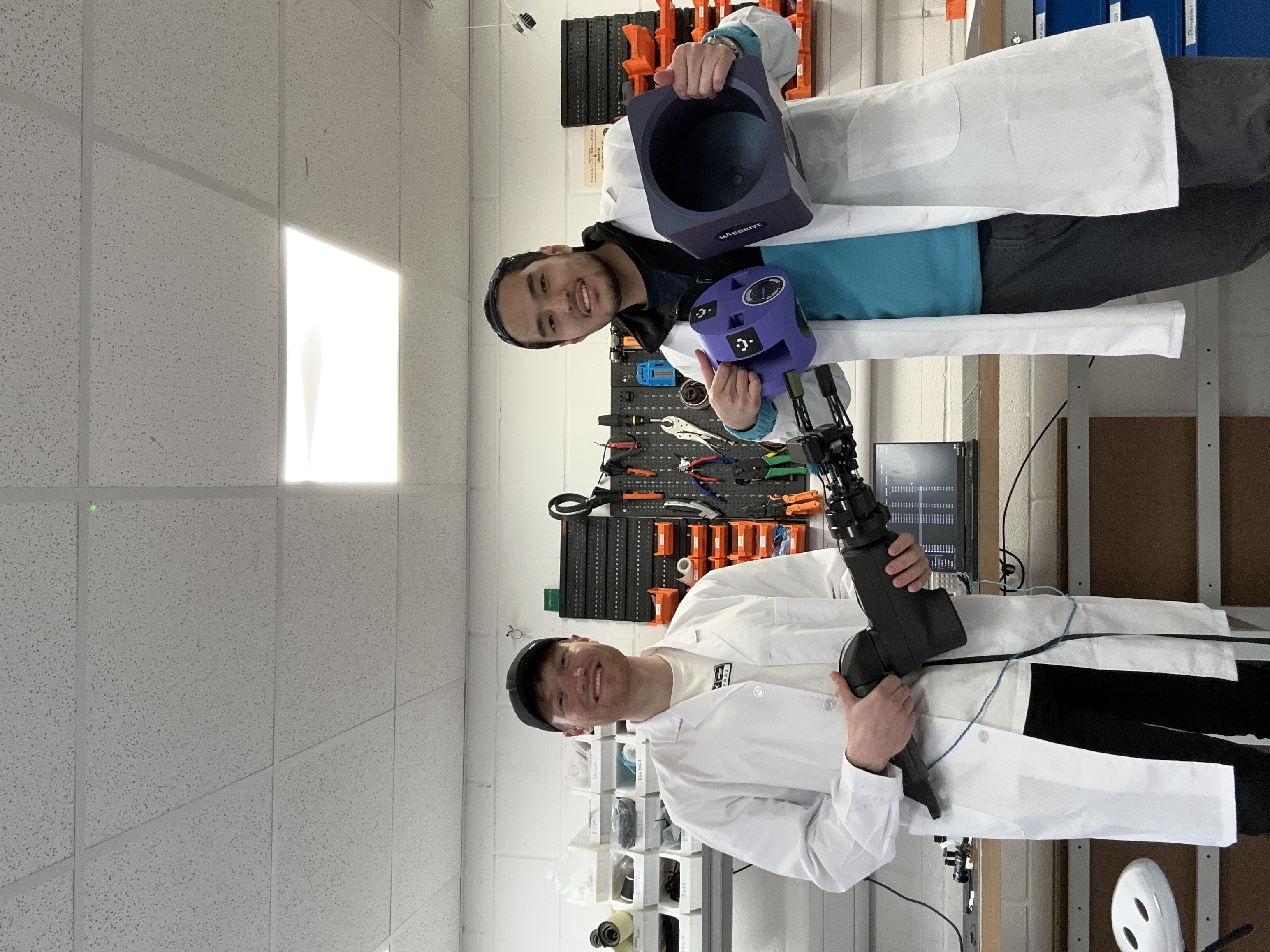
Project photographs, the hardware portfolio and dimensioned drawings document the prototype and its development.
PDF / 6 pages
Requirements, design iterations, test sequence and reported results.
Download hardware portfolioPDF / 3 pages
Original dimensioned drawings for the cartridge, housing and Lazarus end-effector pad.
Download drawing appendixRequirements evidence
Status reflects the project’s prototype-test and design-review assessment; this is not a qualification result. Qualitative and partial statuses are marked in the table.
| ID | Requirement | Source result and evidence |
|---|---|---|
| TLR-01 | Cartridge mass and volume within 12–15 kg, shoebox-scale envelope | Met — Prototype mass approximately 15 kg; geometry within specified envelope. |
| TLR-02 | Cartridge handling compatibility with space robotic arms | Met — Modified Lazarus gripper handled the cartridge reliably in all four padded tests. |
| TLR-03 | Secure latching and locking into Super-Magdrive unit during operation | Met qualitatively — No unintended release during shake, insertion, or ejection with pads. |
| TLR-04 | Controlled ejection of spent cartridges without damaging hardware | Met — Smooth ejection achieved; no visible damage to cartridge, housing, or pads. |
| TLR-05 | Self-guided alignment under minor misalignments during insertion | Met qualitatively — Taper and chamfered entrance provided effective self-centring. |
| TLR-06 | Environmental resistance to vacuum, radiation, and thermal cycling | Partially met — Flight concept uses aluminium; current PLA prototype has only been validated in ground tests. |
| TLR-07 | Operational cycle life over multiple insertion/ejection cycles | Partially met — Limited number of successful ground cycles; no degradation observed, but life testing is incomplete. |
| TLR-08 | Material compatibility with metallic propellant and space environment | Partially met — Materials identified at design level; compatibility has not been experimentally verified. |
| TLR-09 | Compatibility with Lodestar TARS/Lazarus or similar commercial arms | Met — Geometry tailored to Lazarus; tests confirm functional compatibility. |
| TLR-10 | Fail-safe behaviour under incomplete latching, misalignment, or jams | Partially met — No hazardous failures occurred; detailed fault-tolerant mechanisms remain future work. |
Engineering roadmap
Three areas for progressing the refuelling concept.
01 / Instrument
Measure contact loads and quantify misalignment tolerance.
02 / Endurance
Test metallic hardware through repeated insertion and ejection cycles.
03 / Integration
Integrate robotic control, sensing and jam recovery, then test in representative environments.